How Adnoto turns a manual, document-heavy allowance process into a fast, consistent, auditable one.
Key Outcomes
🌟 Faster claim turnaround, same-cycle instead of multi-day
🌟 Consistent policy checks on every claim, every reviewer
🌟 Fewer duplicate or shared-lease claims slipping through
🌟 Full audit trail for every decision
The Challenge
Rental and housing allowances are employer-provided benefits that subsidize an employee’s accommodation costs. They take several forms – direct reimbursement of monthly rent against a submitted lease, lump-sum housing stipends, temporary living expenses during relocation, or company-leased accommodation. In each case, the employer sets a policy cap and requires supporting documents including leases, receipts, proof of address, and tax invoices to justify the claim. These allowances are far more common than many finance teams realize. Among multinational corporations, over 80% provide a housing allowance or benefit to long-term expatriate assignees, and 83% offer host-location housing as a core benefit for short-term assignees.
Rental and housing allowances break down the same way once claim volume grows: verifying a claim properly takes real document review, and that review doesn’t get faster with scale. Employees submit a lease, receipts, and proof of address by email or expense system, and finance checks the numbers by hand against policy caps, eligible periods, and property rules.
That manual cross-checking is where things slip:
- Inconsistent verification. Scrutiny depends on which reviewer picks up the claim.
- Duplicate claims. The same lease period gets claimed more than once across cycles.
- Shared leases. Multiple employees claim under one tenancy without anyone noticing.
- Thin audit trail. Decisions live in email and spreadsheets, not against the claim.
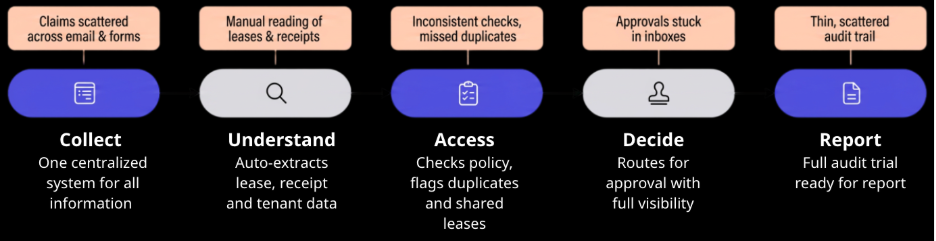
Adnoto’s five-step workflow, applied to rental reimbursement claims
How Adnoto Solves It
Every claim runs through the same five steps. It starts as one structured submission instead of an email attachment. The Document Agent then extracts lease, receipt, and tenant details automatically, turning scans into structured data before a reviewer looks at anything.
The Compliance Agent checks each claim against policy caps and eligible periods, and cross-references tenant names and lease terms across the whole claim pool, catching duplicate submissions and shared tenancies that are nearly impossible to spot by eye. The Advisory Agent turns this into a clear result: what passed, what’s flagged, what’s missing.
From there, the Governance Agent routes the claim to the right approver with role-based permissions, and the Audit Agent keeps a timestamped record of every document, flag, and decision, ready for review at any time.
The Results
- Cost and efficiency. Extraction and first-pass checks that used to consume a reviewer’s time now run automatically.
- Risk management. Duplicate and shared-lease claims get caught before approval, not after an audit finds them.
- Capacity. Every claim runs through the same checks, so the process scales with claim volume, not headcount, exactly when relocation waves or lease-renewal cycles hit hardest.
Rental reimbursement rarely gets the attention other finance processes do, but it carries the same risk: a policy is only as strong as how consistently it’s applied. Adnoto gives every claim the same checks and the same audit trail, no matter who submits it or who reviews it.
Ready to bring consistency, speed, and full auditability to your allowance and reimbursement workflows? Visit Adnoto to learn more or Book a demo with our team to see how Adnoto can fit your policy, your documents, and your approval structure