Wizpresso CEO Calvin Cheng joined finance, technology and policy leaders in Kuala Lumpur to discuss a defining question for the profession: how can finance teams adopt AI at scale while retaining the trust, governance and professional judgement that consequential decisions demand?
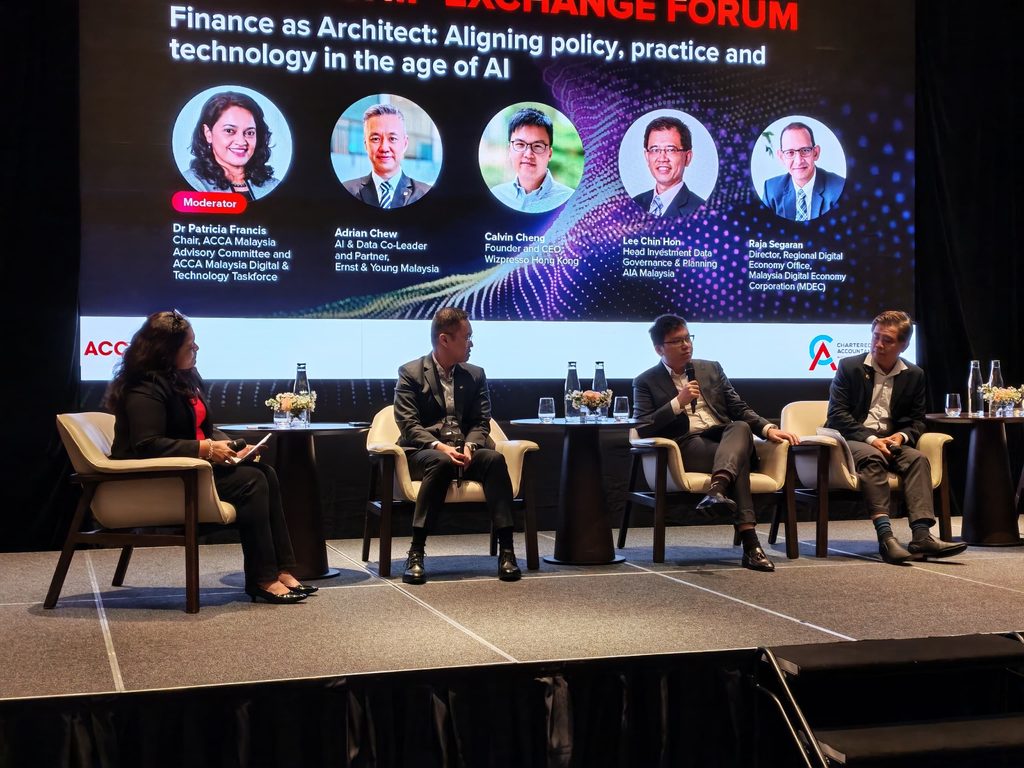
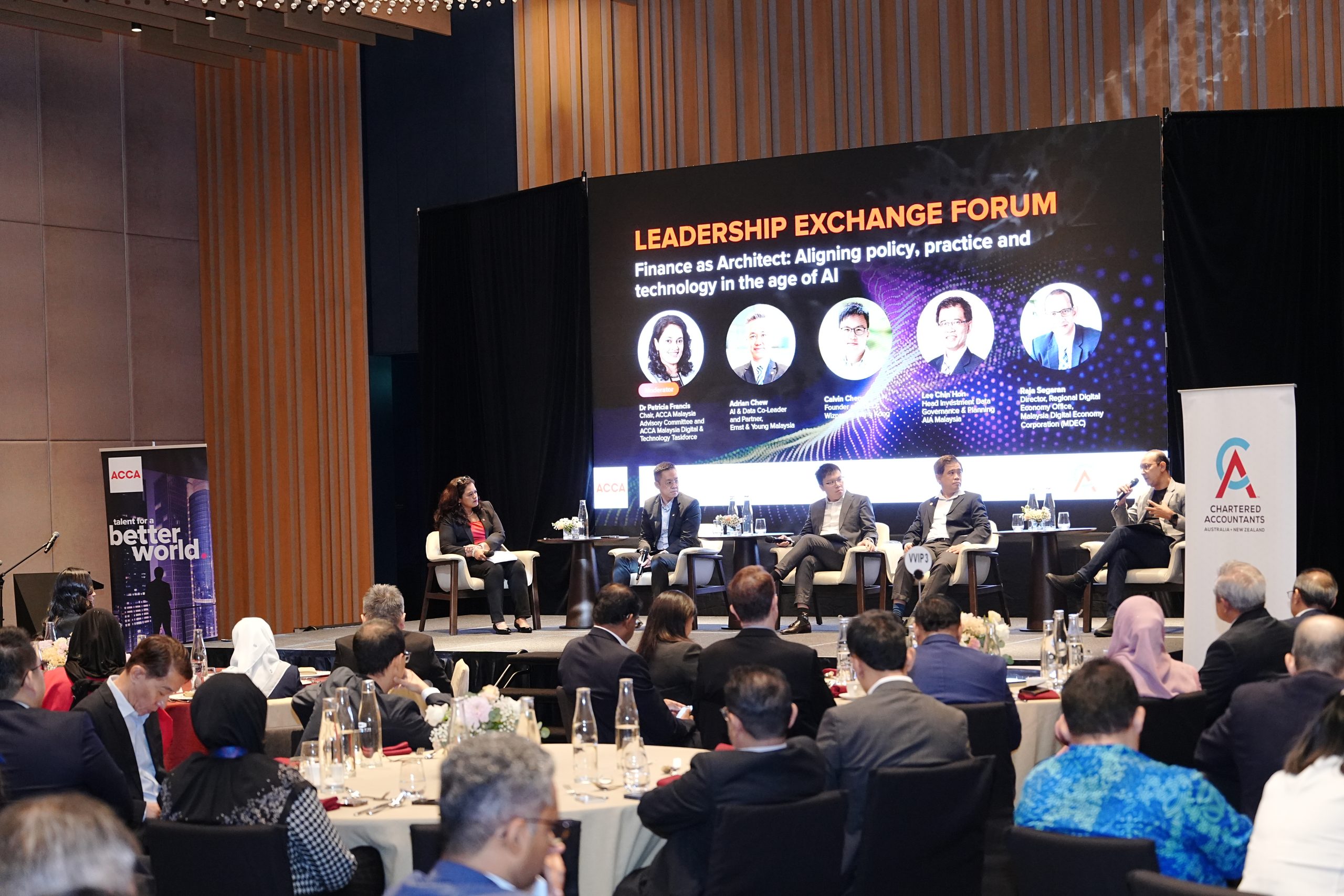
At the ACCA–CA ANZ Leadership Exchange Forum, Finance as Architect: Aligning policy, practice and technology in the age of AI, the discussion focused on turning AI ambition into accountable, measurable business outcomes. Held on 22 September 2026 at Hyatt Regency Midtown Kuala Lumpur, the forum brought together senior leaders from government, financial services, advisory and technology to examine trusted data, workforce capability, responsible implementation and the path from experimentation to value.
Finance’s expanding mandate
The event reflected a wider shift in the finance function. Finance leaders are increasingly expected not only to report on performance and manage risk, but also to help shape how their organisations use data and AI responsibly.
Calvin joined Adrian Chew, AI & Data Co-Leader and Partner at EY Malaysia; Lee Chin Hon, Head of Investment Data Governance and Planning at AIA Malaysia; and Raja Segaran, Director of the Regional Digital Economy Office at MDEC. The panel was moderated by Dr Patricia Francis, Chair of the ACCA Malaysia Advisory Committee and ACCA Malaysia Digital & Technology Taskforce.

The conversation drew on the ACCA–CA ANZ joint research, Enabling Finance Insight: Bridging Skills and Data Gaps for AI-Enabled Finance, which highlights the practical barriers finance professionals face in moving from interest in AI to confident, governed adoption.
Calvin’s perspective: augmented, not autonomous, finance
Speaking from the intersection of finance accountability and AI implementation, Calvin emphasised that AI-enabled finance should not mean handing consequential decisions to a black box.
“AI-enabled finance means combining machine-scale analysis with human judgement, using workflows where every important output is traceable, reviewable and accountable.”
For finance and compliance teams, the objective is not autonomous decision-making. It is better-designed work: AI can search, structure, compare and flag issues at scale, while professionals retain responsibility for materiality, interpretation, escalation and sign-off.
This distinction matters especially in regulated workflows, where a seemingly plausible answer is not enough. A CFO, compliance officer or reviewer must be able to challenge the result and stand behind the final decision.
From pilots to production
A recurring theme of the forum was organisational readiness. While many enterprises are ready to experiment with generative AI, fewer are prepared to deploy it reliably across critical processes.

Calvin noted that purchasing an AI tool is often the easiest step. The more difficult work is defining the use case, agreeing ownership, establishing authoritative sources, setting review requirements and measuring success.
“Most organisations are pilot-ready; fewer are production-ready.”
Rather than waiting for perfect enterprise-wide data, finance leaders can start with a bounded, consequential workflow—such as regulatory-change monitoring, disclosure verification, reporting gap analysis or audit-evidence preparation. The key is to establish a trusted data boundary, clear control points and a named business owner before scaling.
As Calvin put it: “The first implementation question should not be ‘Which model?’ It should be ‘Which decision, which evidence and who signs off?’”
Explainability is a chain of evidence
The panel also explored the growing importance of trust and verifiability. For regulated finance, explainability cannot be limited to an AI policy statement or a model’s self-generated rationale.
Calvin described explainability as a chain of evidence. For any material output, a professional should be able to identify:
- The source evidence used by the system
- The relevant rule, requirement, policy or control applied
- The process used to extract, compare or transform information
- The person who reviewed, overrode or approved the outcome
For example, where AI identifies a potential disclosure gap, the reviewer should be able to inspect the applicable requirement, open the relevant source passage, understand the basis for the alert, assess the proposed action and record the final professional judgement.
“AI may recommend; accountability must remain identifiable.”
This is the principle behind Wizpresso’s approach to AI for regulated workflows: helping teams work faster with source-linked evidence, structured controls, review workflows and audit-ready records—without removing accountable professionals from material decisions.
A practical mandate for CFOs
The session closed with a clear action for finance leaders: focus less on generic AI activity and more on proving value and control in a real workflow.
Calvin’s recommendation was straightforward:
“Choose one consequential, document-heavy workflow and redesign it end to end with AI—rather than launching another general AI pilot.”
That means setting a baseline for time, quality, exceptions and risk; defining trusted sources and mandatory human checkpoints; assigning ownership; and measuring both operational value and control improvement over a quarter.
The opportunity for finance is not simply to automate tasks. It is to architect more resilient, evidence-based and accountable ways of working—where technology strengthens professional judgement rather than substitutes for it.
Wizpresso thanks ACCA, CA ANZ, the moderator and fellow panellists for a thoughtful discussion on the future of AI-enabled finance. We look forward to continuing the conversation with finance leaders building trusted AI workflows across the region.